- Candidate Histories
- Incumbent Races
- Office Histories
- Open Seat Races
- Party Control
- Party Switches
- Race Competitiveness
- Seats That Changed Party
- Split Districts
- Third Party Results

Find
Analyze Results
Republicans Win Fewer Votes, but More Seats than Democrats
Pennsylvania was typical of those states where Republicans benefited in 2012 from the decennial redrawing of congressional district lines. Democratic candidates drew more than half of the total votes cast statewide for the U.S. House last fall, but Republicans won nearly three–quarters (13 of 18) of Pennsylvania’s congressional seats. The GOP–controlled state government approved a map that packed Democratic votes into the five districts that they carried, where the party’s candidates posted winning percentages ranging from 60% to 89% of the total vote. Meanwhile, the Republican vote was spread more broadly, with nine of the GOP winners drawing less than 60% of the vote in their districts.
Source: Rhodes–Cook Letter, Feb. 2013
How to: This table shows the GOP and Democratic victories in Pennsylvania by how much of the vote the winning candidates won. Vote percentages are based on total votes cast.
Use the Race Competitiveness tool to look at House winners with various vote ranges from 1968 to 2010. You can also choose other offices.
2012 Senate Elections: Democrats Mount Strong Defense
Democrats held the Senate last November in part because they were able to win close races on hostile terrain. Ten of the 23 Democratic Senate winners prevailed by margins of less than 55% of the total vote, and five were elected in states that voted Republican for president. On the other hand, just two of the eight successful Republican Senate candidates in 2012 won with less than 55% of the vote, and only one - Dean Heller of Nevada - won in a state that was carried by President Barack Obama. Senate winners are listed below according to their vote share, from the lowest to the highest percentage within each category (Democratic, Independent, Republican).
Source: Rhodes-Cook Letter, Feb. 2013
How to: The first map shows states for which the Senate winner garnered less than 55% of the vote in the general election. Red are Republican victors, blue are Democrats, and yellow are independents. The second map shows states that split the Senate and presidential vote. Purple indicates states that voted for Mitt Romney in the presidential race but a Democrat for Senate; yellow indicates states that voted for Barack Obama in the presidential race but a Republican for Senate.
Use the Race Competitiveness tool to look at Senate winners with less than 55% of the vote in elections from 1968 to 2010. You can also choose other offices and other vote percentage ranges.
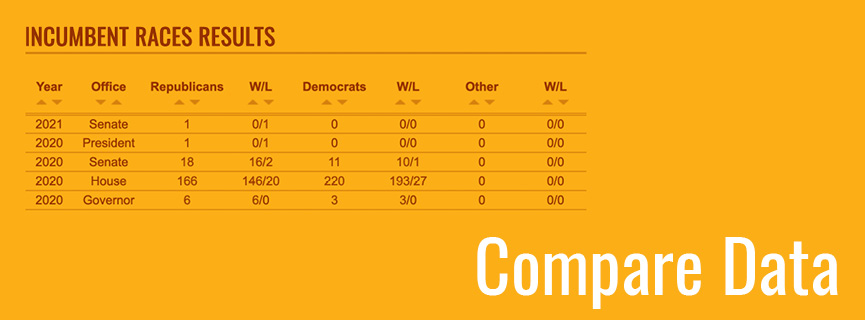
Use the Incumbent Races and Open Seat Races tools to look at data similar to the table below.
Presidency More Democratic, Congress More Republican Since 1992
Democrats thrived in voting for president, the House and the Senate in 2012. They rolled up pluralities in aggregate nationwide balloting for all three levels. That included the House of Representatives, where Republicans still were able to win a clear majority of House seats. Presidential results are from the 50 states and the District of Columbia); House results from all 50 states; and the Senate numbers from the 33 states where contests for the nation’s upper chamber were held. The nearly 11-million vote Democratic edge in the Senate races was built in no small part on pluralities of more than 3 million votes each by Democratic incumbents Dianne Feinstein of California and Kirsten Gillibrand of New York.
Source: Rhodes-Cook Letter, Feb 2013
How to: This graph shows the difference between the total Democratic vote advantage in 2012 among president, House, and Senate races.
Use the Office Histories tool to look at similar vote totals and percentages for president, House, and Senate across the nation, by state, or even by county for any years from 1968 to 2010.